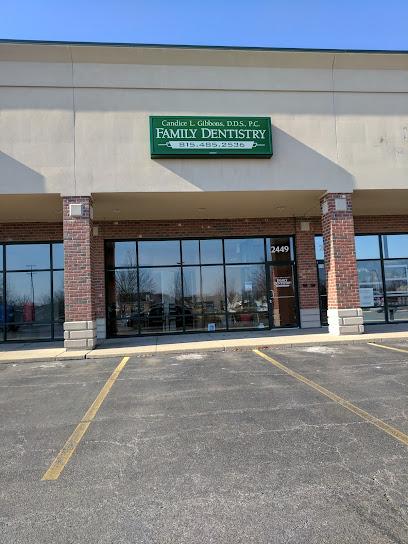
Dr. Gibbons was raised in Joliet, IL.and attended the University of Iowa. She received her bachelor's degree in Biologyin 1993 and continued her education at Iowa's College of Dentistry, graduating in 1997. After practicing as an associate for a few years, Dr. Gibbons opened her own clinic in 2003. Throughout her years of practicing,Dr. Gibbons has prided herself in treating her patients with the most up to date dentistry in a comfortable atmosphere. In her spare time, Dr. Gibbons enjoys going to sporting events and hanging out with her friends and family andplaying with her dog, Chewie. Dr. Gibbons is associated with the Illinois State Dental Society, Will Dental Society, Chicago Dental Society,American Dental Association, New Lenox Chamber of Commerceand the Lincoln Way Area Business Women's Organization. To insure she is current on the latest dental technology, Dr. Gibbons attends many continuing education conferences and seminars every year. Dr. Gibbons and her staff work closely together to ensure her patients have a enjoyable and comfortable dental visit every time. Please contact us today, we look forward to seeing you.
Fluoride Varish: Ahighly concentrated form offluoridewhich is applied to thetooth's surface. It isapplied to theenamel of the tooth and can be used to help prevent decay, remineralize the tooth surface and to treat hypersensitivity.Sealants: Asealantis a thincoatingpaintedon the chewing surfaces of teeth, usually the back teeth (thepremolarsand molars) to prevent tooth decay. The sealant quickly bonds into the depressions andgroovesof the teeth, forming aprotective shieldover theenamel of each tooth.Comprehensive and Periodic Examinations: Information is collected during an examination, which include but not limited tothe health of a patient's gum tissue health, caries identification and oral cancer screening.Digital Radiography:Sensors are used instead of traditional photographic film. Advantages include time efficiency through bypassing chemical processing and the ability to digitally transfer and enhance images. Also less radiation can be used to produce an image of similar contrast to conventional radiography. Panoramic (full mouth film), bitewing (checks bone levels and for caries interproxmially) and perapical (a film of a specific tooth or area),radiography film are a few types of film that we take in our office. Here are a couple examples of those films.Dentures and Partials:Also known asfalse teeth, areprostheticdevices constructed to replace missing teeth; they are supported by the surrounding soft and hard tissues of theoral cavity. Conventional dentures are removable (removable partial dentureor complete denture). However, there are many different denture designs, some which rely on bonding or clasping onto teeth ordental implants, which is a fixed prosthodontics.Implants: Adental implant is a surgical component that interfaces with the bone of the jaw or skull to support adental prosthesissuch as acrown,bridge,denture, facial prosthesis. Implants can be used to replace one tooth or multiple teeth. The implant fixture is first placed, so that it is likely to osseointegrate, then a dental prosthetic is added. A variable amount of healing time is required before either the dental prosthetic (a tooth, bridge or denture) is attached to the implant or anabutmentis placed which will hold a dental prosthetic.The position of implants is determined by the position and angle of adjacent teeth andlab simulations. The final prosthetic can be either fixed, where a person cannot remove the denture or teeth from their mouth or removable, where they can remove the prosthetic. In each case an abutment is attached to the implant fixture. Where the prosthetic is fixed, the crown, bridge or denture is fixed to the abutment with eitherlag screwsordental cement. Where the prosthetic is removable, a corresponding adapter is placed in the prosthetic so that the two pieces can be secured together.Bridges: Abridgeis a fixeddental restorationused to replace a missingtooth(or several teeth) by joining an artificial tooth permanently to adjacent teeth ordental implants. Like crowns, they are bonded to the abutment teeth using a dental cement, a dental impression of the prepare teeth is taken and fabricated by a dental laboratory.Composite/Tooth Color Fillings; Composite resins, or tooth-colored fillings, provide good durability and resistance to fracture in small- to mid-size fillings that need to withstand moderate pressure from the constant stress of chewing. They can be used on either front or back teeth.Composite Bonding:Dental bonding is among the easiest and least expensive of cosmetic dental procedures. Unlike veneers and crowns, which are customised tooth coverings that must be manufactured in a laboratory, bonding usually can be done in one clinic visit unless several teeth are involved.These are some of the services and treatments that Dr. Gibbons and her office provide. If there is a particular services that you have questions about or you wish to inquire about a service not listed, please call our office at (815)485-2536. We would be happy to answerany questions for you.